
Why Is My Driveway Cracking? Austin Causes
Wondering why is my driveway cracking? Learn the common Austin causes, which cracks need repair, and how to protect your concrete investment for years.
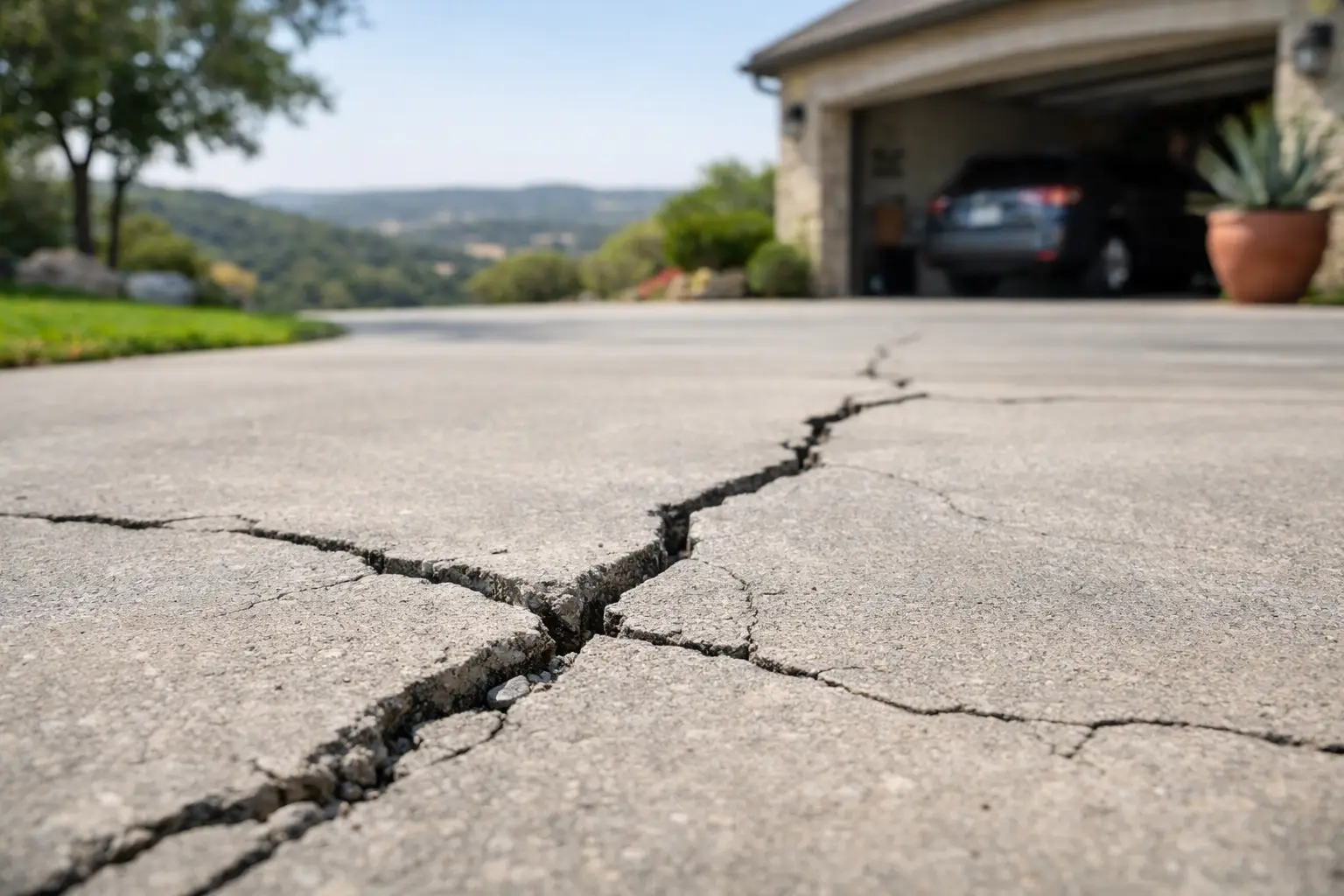
A driveway can look solid for years, then develop a thin line, a broken edge, or a crack wide enough to catch a shoe. If you are asking, “why is my driveway cracking,” the answer is usually not that the concrete suddenly failed. Most cracks start below the slab, around the edges, or at points where the concrete was not given room to move.
In Austin, driveways deal with long heat cycles, heavy rain, expansive clay soil, tree roots, and occasional freezes. Some cracking is normal concrete behavior. Other cracking is a warning that drainage, base preparation, or soil movement needs attention before the damage spreads.
Why Is My Driveway Cracking? Start With the Pattern
The shape and location of a crack tell a contractor more than the fact that a crack exists. A narrow, straight crack across a large slab may be a normal shrinkage crack. A crack that has one side higher than the other points to movement below the concrete. Wide cracks, crumbling edges, and areas that sink near the garage deserve a closer look.
Concrete is strong under compression, but it has limited flexibility. It shrinks as it cures, expands and contracts with temperature changes, and moves when the soil beneath it moves. Control joints are cut into a driveway to encourage concrete to crack in planned locations. When joints are too far apart, too shallow, or missing, the slab often cracks where it wants instead.
A single hairline crack is not automatically a replacement project. The practical question is whether the crack is stable, getting wider, allowing water underneath, or creating a trip hazard. Those details determine whether sealing, repair, slab lifting, or replacement makes sense.
Austin Soil Movement Is a Major Cause
Much of the Austin area sits on clay-heavy soil. Clay expands when it absorbs water and shrinks as it dries. That constant change can leave portions of a driveway unsupported or push sections upward unevenly.
This is especially common when one side of the driveway receives more runoff than the other, when a downspout empties beside the slab, or when irrigation keeps one area consistently wet. During a dry Texas summer, soil can pull away from the underside of concrete. After a hard rain, it can swell again. The driveway is caught in the middle.
Signs of soil-related movement include diagonal cracks, cracks that widen over time, and slab sections that are no longer level with each other. Repairing only the visible crack without correcting the water issue may give you a cleaner-looking driveway for a while, but it will not stop the underlying movement.
Drainage Problems Wash Away Support
Water should move away from the house and off the driveway without pooling at slab edges. When runoff repeatedly flows beneath concrete, it can erode or soften the base material supporting the slab. The result is a void under the driveway. Once vehicles drive across that unsupported area, the concrete can crack, sink, or break at the edge.
Look for standing water after rain, soil washing out along the driveway, downspouts that discharge directly beside the concrete, or mulch and landscape beds that hold water against the slab. Poor drainage is not always obvious from the surface. A driveway may look level while water is working underneath it during every storm.
The fix can involve regrading, extending downspouts, improving drainage paths, or rebuilding affected concrete with the right base. The right approach depends on where the water starts and where it needs to go.
Poor Base Preparation Can Show Up Years Later
Concrete needs a stable, compacted base. If a driveway was poured over loose fill, uneven soil, organic material, or an underprepared gravel base, the slab may settle in sections. Concrete thickness matters too. A thin slab may hold up under passenger vehicles but fail under repeated deliveries, work trucks, trailers, or heavy equipment.
A proper driveway installation is more than pouring concrete into a formed area. The subgrade needs to be shaped, the base needs to be compacted, drainage needs to be considered, and the concrete needs enough thickness and reinforcement for its intended use. Skipping those steps may save money on installation day, but it often creates a repair bill later.
Edges are particularly vulnerable. If the edge of a driveway has no support from compacted material or has been undermined by runoff, it can chip and break away. Parking too close to unsupported edges adds more stress and can turn a small break into a larger failure.
Heat, Curing, and Missing Joints Create Cracks
Austin heat puts fresh concrete under pressure. When concrete dries too quickly during placement and curing, it can develop shrinkage cracks. This does not always mean the slab is structurally unsound, but it can affect appearance and create paths for water to enter.
Control joints help manage that shrinkage. They should be placed at sensible intervals and cut deeply enough to guide cracking. When joints are improperly spaced, concrete may crack between them. When an existing joint is filled with rigid material or sealed poorly, the slab may not move as intended.
Expansion joints also matter where a driveway meets a garage slab, sidewalk, patio, or other fixed concrete. These joints provide separation so slabs can move without pushing against each other. If the material at those connections has failed or is missing, pressure can lead to cracking near the structure.
Trees and Roots Can Lift Concrete
Mature trees add value and shade to an Austin property, but roots and driveways do not always coexist easily. Surface roots can push up a slab section, create uneven joints, and crack concrete from below. Cutting roots without a plan can damage the tree and may not solve the problem if other roots continue growing toward moisture.
When a tree is involved, the repair should account for both the driveway and the landscape. In some cases, targeted root management, a redesigned edge, or replacing only the lifted section is practical. In others, removing or significantly altering the tree may not be worth the trade-off. The best decision depends on the root location, tree health, severity of the lift, and long-term plans for the property.
When a Driveway Crack Needs Professional Repair
Small, stable hairline cracks can often be cleaned and sealed to keep out water and reduce visible staining. That is maintenance, not a structural cure. The driveway should still be watched through wet and dry seasons.
A professional assessment is more appropriate when cracks are wider than about one-quarter inch, when the concrete has vertical displacement, or when pieces are breaking apart. Also take action if water is entering the crack, a slab is sinking, the garage approach is separating, or the same area has been repaired before and failed again.
These conditions can indicate a base problem, drainage problem, or significant soil movement. The repair may involve crack filling, joint repair, removing and replacing a damaged section, rebuilding the base, or correcting drainage before new concrete is placed. Full replacement is not always necessary, but patching is not always the honest solution either.
What Not to Do With a Cracked Driveway
Do not coat over an active crack and assume the problem is fixed. Decorative coatings can improve appearance, but they cannot stabilize moving soil or restore missing support beneath a slab. Avoid letting sprinklers, downspouts, or air-conditioning discharge keep the cracked area wet.
It is also wise not to park heavy vehicles on visibly sunken or broken sections. Weight concentrates stress around cracks, especially near slab edges and voids. If a crack has created a sharp lip, marking the area and limiting traffic can prevent injuries and further breakage while you plan repairs.
Preventing More Cracks After Repair or Replacement
No concrete driveway is guaranteed to remain perfectly crack-free forever. The goal is a driveway that manages movement well, drains correctly, and stays serviceable for the long haul. Keep water moving away from the slab, maintain landscape grading, and inspect joints and seals periodically. If you add new landscaping, avoid creating a raised bed or irrigation pattern that directs water against the driveway.
For replacement work, insist on proper excavation, base compaction, drainage planning, appropriate concrete thickness, and correctly placed control and expansion joints. If the driveway will support work vehicles, trailers, or frequent delivery traffic, say so before the project is designed. The expected load should shape the installation.
A cracked driveway does not always mean your property has a major structural problem, but it should not be ignored. Catching drainage and soil issues early usually gives you more repair options and helps protect the next concrete installation from the same failure.