
Retaining Wall or Slope Grading?
Retaining wall or slope grading? Learn what works best for Austin yards based on drainage, budget, slope, soil stability, and usable space.
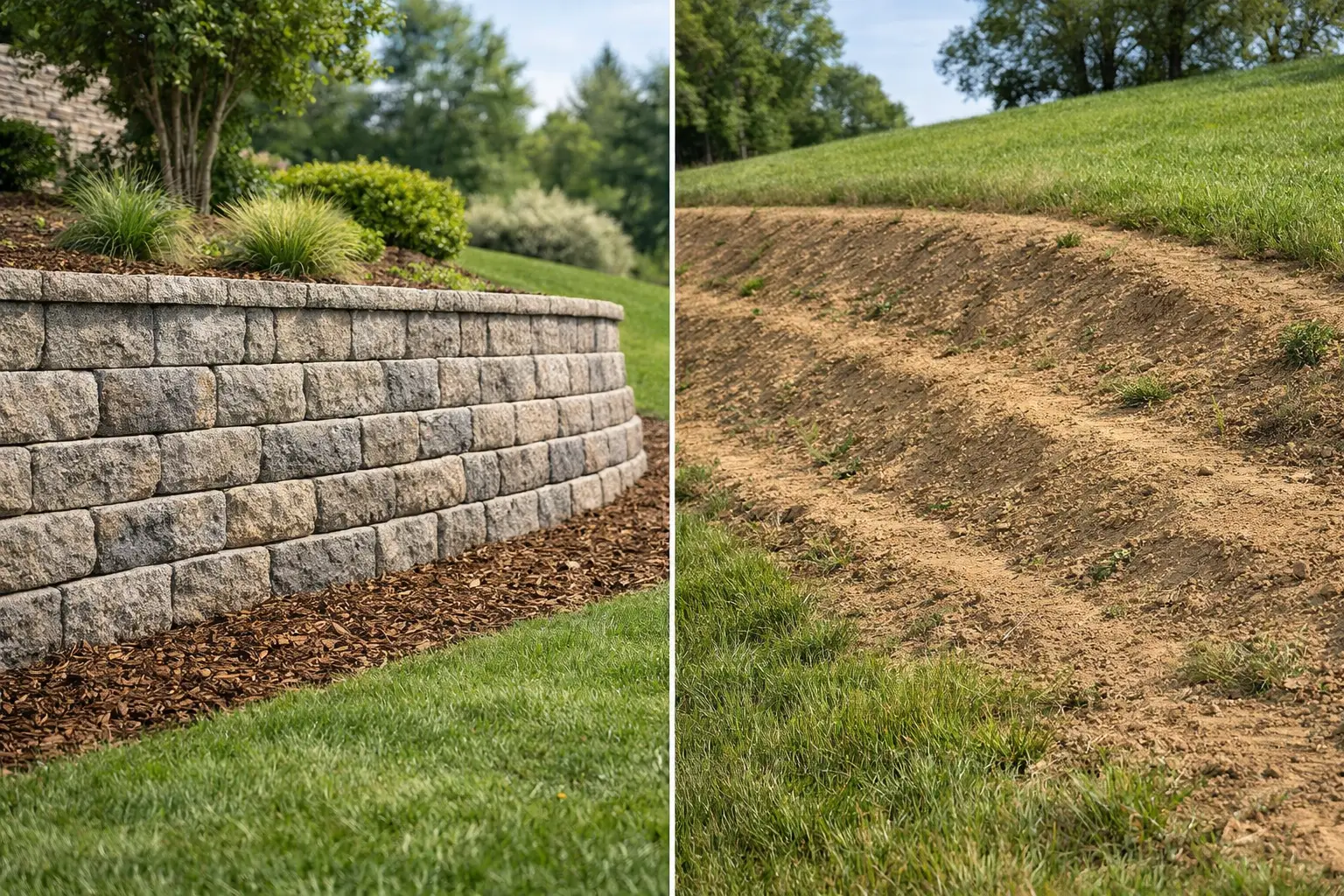
A backyard that drops too fast is not just awkward to mow. In Austin, it can turn into runoff problems, soil washout, foundation concerns, and outdoor space you cannot really use. When property owners ask whether they need a retaining wall or slope grading, the right answer depends on how steep the grade is, where the water goes, how much usable yard space they want, and what the soil is doing after every hard rain.
This is one of those projects where the cheapest option upfront is not always the least expensive over time. A slope that keeps eroding will keep costing money. A wall built where grading would have worked can add unnecessary construction cost. The best choice starts with the site, not with a one-size-fits-all answer.
Retaining wall or slope grading: what is the difference?
A retaining wall holds back soil so you can create a level area where the land naturally wants to rise or fall. It is a structural solution. Done right, it controls elevation changes, helps manage erosion, and can open up more functional space for patios, walkways, planting beds, or lawn areas.
Slope grading reshapes the land into a more gradual transition. Instead of holding soil back with a wall, grading spreads the elevation change over a larger area. This can improve drainage, reduce erosion, and make the yard easier to maintain, but it needs enough room to work.
The basic difference is simple. A wall resists the slope. Grading softens the slope. Which one makes more sense depends on the property layout and the project goals.
When slope grading makes more sense
If the yard has enough horizontal space, grading is often the cleaner and more cost-effective solution. A moderate slope can usually be reworked into a gentler grade that drains better and is easier to mow, landscape, and use.
Grading tends to work well when the main issue is surface runoff or uneven transitions rather than a severe elevation change. For example, if water is moving too fast toward a patio or pooling near the house, regrading may be enough to redirect it. In many Austin properties, especially larger lots, that can solve the problem without the added material and labor of a wall.
There are trade-offs. Grading needs space. If the lot line, fence, driveway, or existing hardscape limits how far the slope can be spread out, there may not be enough room to create a stable, gentle grade. Grading can also reduce flat yard area in some cases because the slope still exists, just over a wider footprint.
Another factor is drainage control. Good grading is not just moving dirt around. The finished elevations have to send water away from the home, avoid dumping runoff onto neighboring property, and account for how the soil behaves after storms. That planning matters as much as the equipment work.
Good candidates for grading
A property is often a good candidate for slope grading when the incline is manageable, the yard has room to reshape the land, and the owner wants a more natural look. It also makes sense when the priority is drainage correction or erosion reduction rather than creating a sharply defined level area.
When a retaining wall is the better option
A retaining wall becomes the stronger choice when the grade is too steep to fix by reshaping alone, or when the property owner needs to preserve usable space. On tighter Austin lots, that is common. If you try to solve a steep drop with grading in a confined yard, the slope can eat up too much of the property.
Walls are especially useful where elevation changes happen quickly, such as behind a patio, beside a driveway, along a fence line, or in a backyard that drops off sharply. In those situations, a retaining wall can create a level section for practical use while also stabilizing soil.
This is also the better route when erosion is severe or when repeated runoff has already started cutting channels into the slope. A properly built wall with drainage behind it can stop the cycle of soil movement more effectively than surface reshaping alone.
The trade-off is cost and construction complexity. Retaining walls require excavation, base preparation, drainage design, structural consideration, and the right materials for the height and load involved. A short decorative wall is one thing. A wall holding back significant soil is structural work and needs to be treated that way.
Good candidates for a retaining wall
A retaining wall usually makes sense when space is limited, the slope is steep, the project needs level ground for a patio or lawn, or the soil is actively failing. It is also often the better fit when the visual layout of the yard benefits from terracing or stronger definition between elevation levels.
Key factors that decide the job
The first factor is slope severity. A gentle to moderate slope can often be graded. A sharp elevation change over a short distance usually points toward a retaining wall.
The second factor is available space. Grading needs room to spread the incline. Walls are better when the project needs to keep the footprint compact.
The third factor is drainage. In Central Texas, intense rain can expose bad grading fast. Whether the fix is grading or a wall, the drainage plan has to be right. A retaining wall without proper drainage can fail. Grading without proper runoff direction can move the water problem somewhere else.
The fourth factor is intended use. If the goal is to gain flat, usable square footage for outdoor living, a wall often delivers better results. If the goal is simply to smooth transitions and reduce washout, grading may be enough.
Budget matters too, but it should be considered alongside long-term performance. A lower-cost grading project that does not fully stabilize the area may lead to repeat repairs. A wall that is oversized for the site may spend money where it is not needed. The right scope is what saves money over time.
Austin conditions change the answer
In the Austin area, soil movement and drainage are not small details. Expansive clay soils can shift with moisture changes, and intense storms can send water down a slope fast. That means both retaining walls and grading plans have to be built around local ground conditions, not just appearance.
Rocky areas can affect excavation and base prep. Clay-heavy areas may need extra attention for drainage and compaction. If water already collects near the home, the yard layout should be evaluated as a full drainage problem, not just a slope problem. A good contractor looks at the relationship between the house, hardscape, existing landscape, and runoff pattern before deciding on the fix.
That is one reason many property owners prefer working with one contractor who understands both concrete and landscape construction. A slope issue often affects more than one part of the yard. It may involve drainage swales, a patio edge, walkways, planting areas, and erosion control all at once.
Sometimes the best answer is both
A retaining wall or slope grading decision is not always either-or. Some properties need both. A common solution is to install a wall where the grade changes sharply, then fine-tune surrounding areas with grading so water moves correctly and the yard transitions look natural.
That hybrid approach can give better results than forcing one method across the whole property. A wall may hold the major elevation change, while grading handles drainage and surface finish. On larger projects, terraced walls paired with controlled grading can make a difficult yard more usable without overbuilding it.
This is often the most practical answer when a homeowner wants both function and curb appeal. The structural part handles stability. The grading ties the whole site together.
What property owners should ask before starting
Before any work begins, it helps to answer a few plain questions. Where does the water go during a hard rain? How much flat, usable space do you actually want? Is the slope causing erosion, maintenance trouble, or drainage near the foundation? Are there fences, driveways, patios, or lot lines that limit the design?
Those answers shape the project more than style preferences do. Material selection matters, but the bigger issue is whether the site is being solved correctly. A wall should not be built just because it looks clean on paper. Grading should not be chosen just because it sounds simpler.
For Austin homeowners, residential investors, and property managers, the best result usually comes from treating slope work as a performance issue first and a landscape issue second. If the ground holds, drains, and functions the way it should, the finished look has a much better chance of lasting.
Texan Strong Builds approaches these projects with that practical mindset. The goal is not to oversell one method. It is to build the right fix for the property, the drainage pattern, and the way the outdoor space needs to work.
If your yard is washing out, staying too steep to use, or pushing water where it does not belong, the right next step is to evaluate the grade before the problem spreads. A well-planned solution now usually costs less than repairing avoidable damage later.